+of+DSCN2645-pola.jpg)


Last year, whilst in Italy, I had the priviledge of seeing two of Baroque sculptor Gianlorenzo Bernini's masterworks: The Rape of Proserpine, and Apollo and Daphne at the Villa Borghese in Rome. Previous to this encouner, whilst I had studied sculpture, it had never really struck me as something overwhelming or inspiring, didn't move me in the way painting and photography did. Largely because my main exposure to sculpture was via a slide projector in a lecture hall, and frankly, when this is the mode of viewing, poor old sculpture just doesn't stand a chance. In hindsight, this seems like a poor excuse -- after all, slides or no, I have plenty of opportunity to see contemporary Australian sculpture in the flesh -- but prior to standing before Bernini's marble virtuosities, completely overwhelmed, I really wouldn't have been in the right frame of mind to appreciate it.

Let's backtrack a bit. Why Bernini, why so overwhelmed? Well, for starters, over the course of my month in Rome, my fellow students and I came to learn that one Gian Lorenzo Bernini was The Man as far as Baroque sculpture is concerned. During the Renaissance, sculpture was largely concieved as something static, to be viewed from a fixed point. Flemish sculptor Giambologna began to challenge this static notion of sculpture, with works such as The Rape of the Sabine Women being characterised by intertwined figures and a sense of dynamic movement. Bernini takes Giamobologna's initial advances and perfects them, and with Apollo and Daphne and The Rape of Proserpine there is most certainly not a fixed viewing point, but rather the sense that from every angle, a new aspect of the narrative is conveyed. Moreover, at every angle, the marble seems to take on a different character. Pluto's fingers stab into Proserpine's thigh, making deep indents. Her leg looks fleshy and soft, as if it would wobble when touched. At the other side of the statue, Pluto's leg is entirely different - an epotiome of chiseled musculature. As we move around, our focus shifts from Pluto's sheer masculine power, to Proserpine's sheer terror. Her toes are curled and a tiny tear winds its way down her cheek.


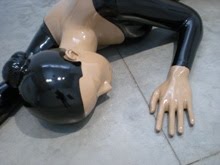
So there you have the starting point for my blossoming relationship with sculpture. Fast forward to June 2009 when I was back in New Zealand. Left in my hometown on a weekday with my friends and family all either at work or school, where else did I go but to the Auckland Art Gallery. At present, the gallery is in the middle of a multi milion dollar renovation and extension, and as such only the "New Gallery" across the road from the older, main gallery is open. Disorganised as I was, I arrived not even knowing what exhibitions were showing, and was pleasantly surprised to find an entire floor dedicated to an exhibition of the gallery's recent acquisitions. Whilst all the works on display were fantastic in their own right, my clear favourite was in the very last room, and in fact had the entire room to itself. Michael Parekowhai's The Song of the Frog is massive, dominating the entire room. It is hard to capture its impact in words: essentially it is a giant fibreglass ballerina, lying prone on the gallery floor. But a closer look reveals that despite her Barbie-like pink legs, the ballerina's face and hands are brown. This, coupled with Parekowhai's use of fibreglass and automotive paint, gives a starting point for exploring the undercurrent of satire and social commentary contained in his work.


So, Bernini, then Parekowhai, and I still have yet to mention the artist who has inspired all this sculpture related verbosity: Ricky Swallow. That's right, I managed to see his show four times but somehow missed posting about it until the damn thing had finished. And given how wordy I have been about Bernini and Parekowhai, I'm not even going to tell you anything about Swallow right now - that will have to come tomorrow, as The Bernini Effect part two. You see Ricky Swallow's NGV show was so awesome that a rushed description at the bottom of a mammoth post will just not do it justice. Oh no, it deserves verbosity all to itself. Stay tuned.


So there you have the starting point for my blossoming relationship with sculpture. Fast forward to June 2009 when I was back in New Zealand. Left in my hometown on a weekday with my friends and family all either at work or school, where else did I go but to the Auckland Art Gallery. At present, the gallery is in the middle of a multi milion dollar renovation and extension, and as such only the "New Gallery" across the road from the older, main gallery is open. Disorganised as I was, I arrived not even knowing what exhibitions were showing, and was pleasantly surprised to find an entire floor dedicated to an exhibition of the gallery's recent acquisitions. Whilst all the works on display were fantastic in their own right, my clear favourite was in the very last room, and in fact had the entire room to itself. Michael Parekowhai's The Song of the Frog is massive, dominating the entire room. It is hard to capture its impact in words: essentially it is a giant fibreglass ballerina, lying prone on the gallery floor. But a closer look reveals that despite her Barbie-like pink legs, the ballerina's face and hands are brown. This, coupled with Parekowhai's use of fibreglass and automotive paint, gives a starting point for exploring the undercurrent of satire and social commentary contained in his work.


So, Bernini, then Parekowhai, and I still have yet to mention the artist who has inspired all this sculpture related verbosity: Ricky Swallow. That's right, I managed to see his show four times but somehow missed posting about it until the damn thing had finished. And given how wordy I have been about Bernini and Parekowhai, I'm not even going to tell you anything about Swallow right now - that will have to come tomorrow, as The Bernini Effect part two. You see Ricky Swallow's NGV show was so awesome that a rushed description at the bottom of a mammoth post will just not do it justice. Oh no, it deserves verbosity all to itself. Stay tuned.
Michael Parekohwai, Song of the Frog taken by me
Michael Parekohwai, Horn of Africa from here
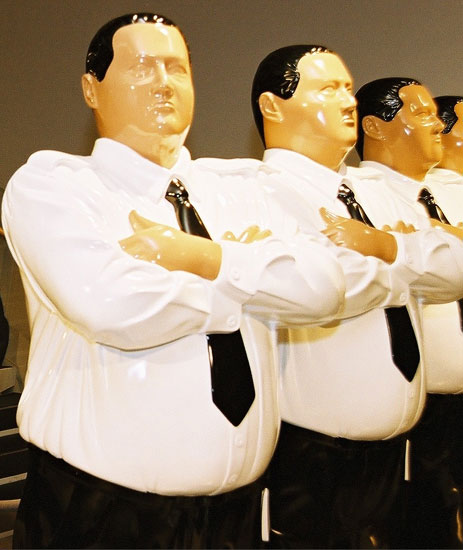
Michael Parekohwai, Kapahaka from here










.jpg)









 Posts
Posts