Showing posts with label australia. Show all posts

May 2, 2010

between the salt and stars


A few weeks ago (ie pre house-imposed-internet-silence), ABC arts covered photographer Murray Fredericks' project Salt. For a number of years, Fredericks made an annual pilgrimage to South Australia's remote, moon-like Lake Eyre. The lake is bare, and featureless, yet this very featurelessness makes it a blank canvas for the shifting colours of light throughout the course of the day and into the night. Salt is both an ongoing photographic project, and a documentary of Fredericks' time at Lake Eyre. As several reviewers point out, the resulting film becomes as much about Fredericks' emotional journey as it does about documenting the lake. Breathtaking natural beauty is juxtaposed with extreme isolation, not to mention the challenges posed by environmental conditions.

In addition to documenting the lake via still photographs, Friedricks also made several time-lapse films. Timelapse photography has always been a favourite of mine, and when you combine this with racing clouds and spiralling star streams the result is nothing short of amazing. I can't embed the snippets of time-lapse, but you can check them out via the website for the Salt documentary. Highly reccomended. At risk of sounding very lame indeed, I got that 'you-are-small-and-insignificant-punch-to-the-gut  feeling from them, well and truly. And, on that note, enough of me; time to be mesmerised by Fredericks' photography. If you scroll down to the bottom I've embedded the trailer for the documentary, which is also worth investigating.


images 1-3 from Arc One gallery's website
images 4-8 from the Salt website


Apr 1, 2010

Art crush - Fiona Hall

I first saw the work of Australian artist Fiona Hall at the NGV's Contemporary Commonwealth exhibition in 2006. Leaf Litter, from 2000 was exhibited alongside Tender, from 2003-05. Both pieces deal with the conflicted role that money plays in contemporary, multicultural society, and contrast the socialised concept of money, with natural, organic items - respectively leaves and bird nests.

 Fiona Hall, Tender, 2003-2005
images from Roslyn Oxley9


Fiona Hall, Leaf Litter, 2002
images from Roslyn Oxley9

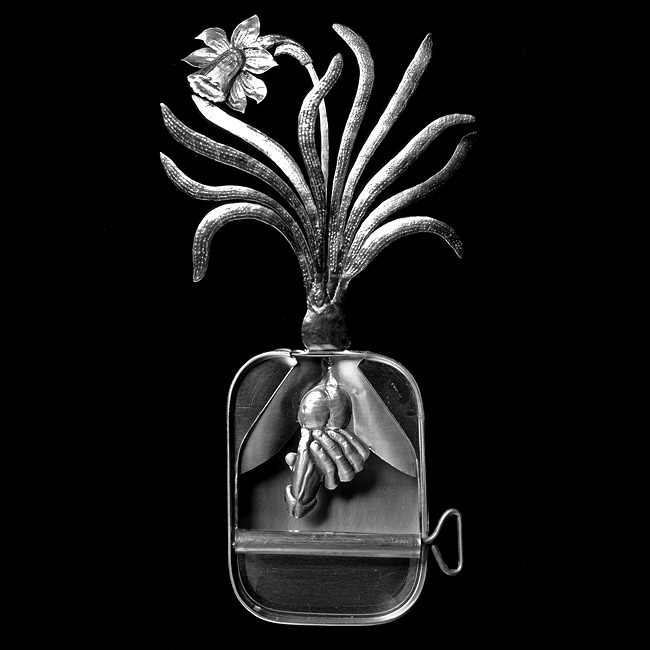
In an earlier series which I haven't seen in person, Paradisus Terestris, Hall creates intricate botanical sculptures out of sardine tins. The delicate, silvery sculptures speak of the vulnerability of plant species, and of the biodiversity present in Australia. Furthermore, the name of the series evokes themes of the garden of Eden, 'Paradise on Earth.' NB these ones are somewhat NSFW. Just a heads up.


  Fiona Hall, Paradisus Terestris 1989-90
images from Roslyn Oxley9

Sep 22, 2009

Killing time until Ricky Swallow


Ok, so I did enjoy my trip to see ol' mister Dali, despite my apprehensions. But ever since, I have been feeling a little bored by the prospects at the NGV. Enter, stage left, contemporary Australian artist Ricky Swallow. Oh wow, oh wow, oh wow. Things are looking up.

Swallow creates intricately detailed sculptures of seemingly insignificant objects, everyday objects which have been rendered arbitrary through familiarity and regular usage. Pop culture objects which we all hold dear, yet don't think about in detail due to a cloud of nostaligia. Well, detail is Ricky Swallow's middle name, and his sculptures reinvent these forgotten objects, making them eternal rather than transient, and infusing value through both his choice of material and through the laborious process of hand carving. Did I mention, wow?

The NGV has subtitled the exhibition "The Bricoleur," which leaves itself open for several interpretations. The word itself is a little ambiguous, given that it has been borrowed into English from French, and translation is a slippery game at the best of times. Even I can't concretely say what I think it means. Having sifted through several definitions, the common understanding is that bricolage involves assembling art from disparate materials, making something from the bits and bobs you find around you. I find this a bit odd when used to describe Ricky Swallow, because despite various media featuring throughout his oeuvre, each sculpture is made from one carefully selected medium. The whole sculpture. And they are sculptures, too, not assemblages. That said, and this is where the issue of translation comes into play,bricoleur can also mean "to tinker," or "to fiddle," and the fiddly, painstaking detail on Swallow's sculptures makes such a term ideal for him.

The NGV explains its use of the term 'bricoleur' thus:
Like the bricoleur put into popular usage by anthropologist Claude Levi-Strauss in his seminal book The Savage Mind, Ricky Swallow creates works of art often based on objects from his immediate surroundings. His method, however, is more of a second order bricolage: his sculptures are not assemblages of found objects, but rather elegantly crafted things.

I would argue that there is a distinct difference between sculpture and/or art MADE FROM one's everyday surroundings, and art BASED ON objects from the everyday. The fact that Swallow's sculptures are carved from high quality timber works to create an ironic contrast with their subject matter. Form and medium have a complex and shifting interrelationship. Furthermore, the term bricolage carries associations of a hasty, roughly constructed item, which does not fit with the laborious, painstaking nature of Swallow's sculptures. Maybe I am reading too much into this, then again maybe I am just exited to have something new to talk about rather than Freudian dreams and anamorphic land masses. Bricoleur or no, I say bring on Ricky Swallow!

[Images of Swallow with Killing Time from here, here and here. Detail of Killing Time from the artist's website.]
Aug 26, 2009

The Michael Issue: Installation One - Michael Z

Art-crush-the-first is Australian artist Michael Zavros. Zarvos' work from the first half of the 2000s is based on the shiny, yet shallow, world of male fashion. There is a sense of the insincerity, and transient, hollowness of the people and things which populate this world, yet also at a deeper level, Zavros makes us think about the extent to which we idealise male beuty, and furthermore about the historical tradition of male beauty. This lineage becomes especially clear in works from 2005 which fuse male runway models sporting the latest designer ranges, fused with horses to form twentyfirst century centaurs, powerful and beautiful. In Zavros' world, beauty is power, and surface is everything. The importance of the 'surface' of things functions at a more literal level in Zavros' more recent work, in which the luxe world of male fashion is replaced by the opulence of the palace. Works from 2006 onwards combine princely architecture with dreamy, otherworldly - often subversive- accents, all of which is depicted in photorealist detail. The familiar bulk of the palace of Versailles is lightened by the image of a heart formed from birds flying overhead. The title, "I ♥ Versailles" further hints at pop culture's appropriation of cultural heritage, and draws attention to the otherwise subtle heart device.

Michael Zavros' works are lush, detailed, and in as good a way as possible, given that the word is used derisively as often as it is used as a compliment, incredibly beautiful. I could stare at them for hours. If only I had a trust fund and a very large wall to hang them on. Anyway, enough of me, time for some of the man himself. Stay tuned my for Michael-crush number two - Michael P, otherwise known as New Zealand artist Michael Paraekowhai. Coming soon.

L.V. Ennui, 2007

The Stone Pavilion, 2008


Iloveversailles, 2007

Le Fontaine de la Sang, 2007

Love's Temple, 2007
Yves Saint Laurent Le Smoking/Bay, 2006

Potsdam interior/ San Souci/ Sometimes I just want to be by myself, 2003

The Salone del Poussino, 2002


Paul Smith, 2001

[All images from Zavros' website, http://www.michaelzavros.com/]

May 31, 2009

Art-crush (teaser)


I am just a little obsessed with Laith McGregor's biro sketches of fantiastical bearded men. The use of biro not lends the work not only a sense of nostalgia (doodles in the margins of exercise books, anyone? -- not that they were ever this good!), but also a feeling of intimacy. This is not about big, gutsy brush-strokes, nor eye catching, blossoming colour. Instead, McGregor conveys a delicate fastidiousness that fits well with the rigid mathematical nature of the hexagon formed by the men's beards.

The beard motif veers dangerously close to becming repetitive, but is saved by the way McGregor uses it to make wry commentary on the status of both facial hair as a marker of identity, but also the status of beard imagery in contemporary culture.

See exhibits A-D to verify this proliferation of beardiness:


McGregor featured in not one but two exhibitions that I missed this year: Sydney's MCA's I Walk the Line: New Australian Drawing, which I missed thanks to being bogged down in essays about Baroque Rome; and a solo show at the Helen Gorrie gallery in Melbourne, which was mysteriously closed when I went there during what should have been its opening hours. Needless to say I was a little heartbroken.


Hex


Untitled, 2

Noel

Related Posts with Thumbnails