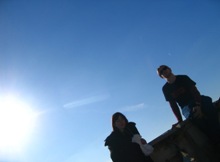
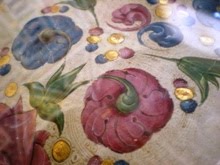
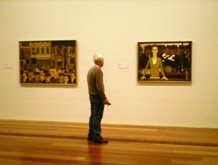
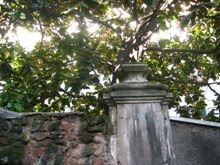
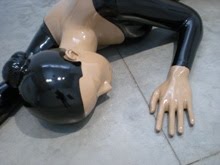
Remember how jazzed I was about Hold Your Horses' video clip for Seventy Million, which featured all the famous paintings, and was fun and silly at the same time? Well, less silly but still awesome is Spanish magazine Ae's take on Gustav Klimt, by photographer Moises Gonzales. Witness:
That third one is my favourite. So much detail! So many flowers! I think far from rolling in his grave, old Mr Klimt would love it too. Found at bumbumbum, via Unstage.
Showing posts with label art. Show all posts
Nov 23, 2010
Nov 19, 2010
an ocean and a return
still from Ocean Without a Shore Venica Biennale installation
image credit www.billviola.com
Midway thorough writing my thesis, before the self-imposed blog hiatus, I started composing a post about my trip to see the National Gallery of Victoria's installation of Bill Viola's Ocean Without a Shore. I didn't really know much about Viola beforehand, but the Age's writeup described the work as "epic, religious, devastating personal, poetic." This was something I needed to see for myself.
Ocean Without a Shore was first exhibited at the 2007 Venice Biennale, where it was installed inside the tiny fifteenth century church of San Gallo. The work explores the tentative threshold between dead and living, or as Viola himself puts it, "the presence of the dead in our lives." The installation consisted of three large video screens superimposed over the altars of San Gallo. Shadowy figures walk towards the viewer, becoming increasingly clear, until they break through a wall of water, imperceptible until the moment of contact. The violently cascading wall of water serves as a representation of the threshold between life and death: the intangible yet ever-powerful 'veil' separating the living from loved ones who have died. Once on the other side of the water wall, the figures appear in full colour, their gazes confronting and emotional. After a short time, each turns and passes back through the veil of water. The figure gradually fades to obscurity, and is replaced by another, approaching one of the other two screens.
The National Gallery of Australia's installation of Ocean Without a Shore uses a small, darkened room to evoke the intimacy of the work's initial showing. Even without the church setting, the overall effect is overwhelming and emotive. Viola reminds his viewers of the extent to which humans are obsessed with death by powerfully conveying the desire to 'see' loved ones who have died. Regardless of one's stance towards religion and the afterlife, the sense of loss as each figure disappears through the veil is palpable. All this, for video projections of strangers. Why? Because Ocean Without a Shore addresses our relationship with death as a universal experience. Death, and its implications, are something everyone must grapple with, and one person is as powerless as another to thwart it.
image credit: designboom
The National Gallery of Australia's installation of Ocean Without a Shore uses a small, darkened room to evoke the intimacy of the work's initial showing. Even without the church setting, the overall effect is overwhelming and emotive. Viola reminds his viewers of the extent to which humans are obsessed with death by powerfully conveying the desire to 'see' loved ones who have died. Regardless of one's stance towards religion and the afterlife, the sense of loss as each figure disappears through the veil is palpable. All this, for video projections of strangers. Why? Because Ocean Without a Shore addresses our relationship with death as a universal experience. Death, and its implications, are something everyone must grapple with, and one person is as powerless as another to thwart it.
image source: designboom
(last image is of the Venetian church, San Gallo)
I had the idea that Viola was using the universal human experience as a means to evoke an emotional response but it didn't really crystallise until I saw another of his works, The Raft. Based on Gericault's Raft of the Medusa, The Raft is a short film, which shows a group of strangers (seemingly waiting for a bus?). They stand together, but apart, each studiously avoiding contact with the others. This continues for some time, with slow motion capture used to highlight the minutiae of the group's gestures. Then, just as excruciatingly slowly, a giant wave of water begins to appear from the left of the frame, crashing over and inundating the crowd of people. They are washed - no, battered - by a solid wall of water for what seems like an eternity. Finally, the water recedes, leaving this once nonchalant crowd completely bowled over, clinging to each other for comfort and security. Here the universal theme that Viola is dealing with is suffering. more specifically the unifying effect of collective suffering.
image credit: University of California Humanities Research Institute
Suffering also comes up in yet another Viola piece that I saw recently, this time at the Australian Centre for Contemporary Art. Unspoken features the faces of a man and a woman, projected onto panels of beaten metal - silver and gold, respectively. Both faces show signs of intense grief and anguish, which, as in The Raft, is further emphasised by Viola's use of slow motion. The panels glow in the darkened room in a way reminiscent of religious icons, an analogy which is borne out by their powerful emotive, almost mystical effect.
[Edit: after a bit of further research into The Passions, the series of works which Unspoken belongs, it transpires that Viola was studying late Medieval devotional images at the Getty Research Institute in Los Angeles. This is also a good point to mention the wealth of information on Viola's work that can be found on both the National Gallery of Australia and the Getty Institute's websites, from a 2003 exhibition of The Passions. The Getty's site has clips from Viola's videos, and notes the connections between them and historical paintings, as well as providing excerpts from Viola's notebooks and explanations of his processes. Well worth a visit.]
With Unspoken, as with Ocean Without a Shore, I felt like I could spend hour upon hour simply staring at the work. As a general rule, I tend to dislike video art - I find most examples of the medium to be repetitive, smug, and detached to the point that they induce boredom. Viola's work is none of these things. It is immersive and direct, and above all, it is moving. This, for me, is the masterstroke. And given that this is quite possible my most text-heavy post yet, I'll leave it at that.
image credit: me!
miraculously managing not to shake
[Edit: after a bit of further research into The Passions, the series of works which Unspoken belongs, it transpires that Viola was studying late Medieval devotional images at the Getty Research Institute in Los Angeles. This is also a good point to mention the wealth of information on Viola's work that can be found on both the National Gallery of Australia and the Getty Institute's websites, from a 2003 exhibition of The Passions. The Getty's site has clips from Viola's videos, and notes the connections between them and historical paintings, as well as providing excerpts from Viola's notebooks and explanations of his processes. Well worth a visit.]
With Unspoken, as with Ocean Without a Shore, I felt like I could spend hour upon hour simply staring at the work. As a general rule, I tend to dislike video art - I find most examples of the medium to be repetitive, smug, and detached to the point that they induce boredom. Viola's work is none of these things. It is immersive and direct, and above all, it is moving. This, for me, is the masterstroke. And given that this is quite possible my most text-heavy post yet, I'll leave it at that.
Labels:
art,
Bill Viola,
NGV,
Ocean Without a Shore,
The Raft,
Unspoken,
Video
Jun 23, 2010
Art crush: Cassandra Laing
Cassandra Laing, Fortune Teller (it will all end in stars), 2007
image source: BonesMagazine
As an art nerd, there are few things that frustrate me more than seeing a beautiful painting/drawing/sculpture/photograph, and not being able to find out the name of the artist responsible. The I-must-know-more itch gets worse if it's a piece of art you bump into frequently, as has been the case with a large scale drawing by Cassandra Laing which looks over the foyer of RMIT's art gallery, where I have been volunteering over the past few months. Cassandra Laing, did you say? ID-ed at last?!
My art stalkerage usually takes discovery of artist's name as its point of departure, moves to scouring gallery listings and portfolio websites, poring over bios, and finishes up with me saving sets of images to drool over at a more convenient time (wow, I managed to make that sound really creepy, huh? This is art we're talking about, people!). However googling Cassandra's name produced very few results, several of them dead ends, others references to an America's Next Top Model she shares her name with. The little information I do have comes from a rather moving article written by The Age's senior arts writer, Gabriella Coslovich, back in 2007. Laing's incredibly detailed pencil drawings draw on themes of death and fragility for a very valid reason: Laing lost her sister to cancer in 2001, and was herself diagnosed with breast cancer in 2006. Her move from painting to drawing was motivated by the effects of chemotherapy and radiotherapy treatment - yet rather than seeming like a mere neccessity, Laing's choice of medium seems completely appropriate for the delicay and poignancy of her images. The eye-popping level of detail in Laing's works is offset by their sheer scale - Fortune Teller (it will all end in stars) is over a metre in width and height.
The message of Fortune Teller becomes even more powerful when we learn of Laing's illness. She is commenting on our how we try to both know and control the future, and on the fultilty of this drive in the light of our insignificance against the backdrop of eternity, the cosmos. Whether it comes abruptly and early, or at the end of a long life, death is irrefutable, and we, like the origami forms Laing depicts, are beautiful, complex, but ultimately fragile and short lived.
Wow. That's a lot of philosophising right there. I guess it goes to show the level of emotional response great art can provoke. I acknowledge that not everyone who sees Cassandra Laing's work will feel as strongly about it as I do -- I am biased: I especially like drawing, and cancer is a longstanding fear of mine, so her story is especially moving -- but I think it would be hard to look at it an deny its brilliance, purely on a technical level. Now if only I could locate more of Laing's work, and sit and stare at it for hours on end...
Cassandra Laing, Darwin Girls, 2006
image source: The Age
Jun 2, 2010
RIP, LB
One of the twentieth century's most influential sculptors, Louise Bourgeois, died on Monday aged 98. Bourgeois' work was largely unknown until the artist was in her sixties and seventies, despite the fact that over the course of her life she produced some of the most challenging and confronting sculpture of the twentieth century.
Bourgeois' sculpture is large scale, psychologically loaded, and frequently unsettling. The now eponymous giant cast iron spider is a testament ot all these qualities. The work's title, Maman (French for mother) shakes things up even further. Who would call a spider Mum? What kind of feelings does Louise Bourgeois expect us to feel for this behemoth arachnid? Yet the knowledge of its title completely changes our experience of the sculpture. Suddenly Maman is much more than just a giant spider: the work is a meditation on relationships, protection and vulnerability. Plus, by having people walk underneath the statue, Bourgeois says as much about the pregnant relationship between viewer and art object as Donald Judd did back in the sixties.
Other works reference sexual ambiguity, human frailty, and in the case of Cell (Glass spheres and hands), which can be found at Melbourne's NGV, the complexities od childhood. I've only briefly studied Bourgeois, so am certainly not the most authoratative source. If you do want to read a little more about her, there is an excellent write up at the art daily with Lydia, which I stumbled upon while googling Louise Bourgeois, and will now be keeping an eye on. There is also an intellgent and thoughtful article at the New York Times.
Image credits:
1. Maman at Milan's Musem di Capodimonte
2. Cell (glass spheres and hands) fromt he National Gallery of Victoria's permanent collection
3. Maman at the Tate, London
May 15, 2010
a bit of Balla
Giacomo Balla, Bankruptcy, 1902
I am struggling away trying to have a draft of the first chapter of my thesis ready for Wednesday, and all I want to do is get out of the house...to the art gallery, to a cafe, more than anything else to take a walk with my camera. For now I am making do by enjoying the gentle stillness and poignancy of some pre-Futurist Giacomo Balla goodness. Isn't it exquisite? Can you belive that it was painted in 1902? It wouldn't look out of place at some trendier-than-thou Flinders Lane art gallery, methinks. Good ol' Balla.
Apr 8, 2010
030910
Broken Bells is a collaboration between producer Dangermaus and Shins frontman James Mercer. Given that the release date of their self-titled album also happened to be my birthday, it's really not too surprising how awesome it is. Anything that happens on the ninth of the third is clearly destined for greatness.
The High Road
Broken Bells | MySpace Music Videos
My favourite track is The Ghost Inside, but it doesn't seem to have a video released yet. You can listen to it here though. Soooo good.
The cover art Broken Bells is by the very talented Jacob Escobedo. The more ritzy, deluxe versions of with the album feature even more of his work, which is in equal parts trippy, colourful and amazing.
all images from http://jacobescobedo.com/
PS: The Broken Bells album launch? Oh, you know, just a casual rooftop laser party. I'm not jealous at all, Los Angeles.
(video found via Jacob Escobedo's website)
Labels:
art,
Broken Bells,
illustration,
Jacob Escobedo,
music
Apr 4, 2010
Budget-girl blues
Jessica Hische, Daily Drop Cap 1st Edition
image credit: Lamington Drive
flatmates and I have just signed the lease to a new house, and while I am endlessly excited about the big move, new house = new expenses = one rather battered and bruised wallet. As such I have made a few resolutions for the next few months. No more buying magazines to get me through my wait for the train. No buying clothes, unless they are ten dollars or less (ahoy, Savers!). No more going out for dinner - daytime coffee will suffice. And last but not least, no mroe buying arty things, especially seeing as I have a backlog of prints which need to be framed. It is in this spirit that I post this amazing prints by American graphic designer Jessica Hische. Jessica recently had a show at my favourite Melbourne gallery, Lamington Drive (home of my very first art-purchase). Largely based around Jessica's Daily Drop Cap project*, the show featured an entire alphabet of intrically designed letters, and additional text-based work. But my favourite things of all, the ones tempting me to break my resolution just days after it was made, were her charts of her drop-cap series, featuring the entire alphabet on one print. For now, I will post one and pretend that this is in fact the same as buying. Then in a few months, maybe, just maybe there will be a few left. Fingers crossed and i's dotted!
images from Daily Drop Cap 1st Edition from Jessica's website
*Go check it out! Jessica is offering a new drop cap a day to bloggers to use to beautify their posts.
The M & Y at the beginning of this post are, of course, from Daily Dropcap
Apr 1, 2010
Art crush - Fiona Hall
I first saw the work of Australian artist Fiona Hall at the NGV's Contemporary Commonwealth exhibition in 2006. Leaf Litter, from 2000 was exhibited alongside Tender, from 2003-05. Both pieces deal with the conflicted role that money plays in contemporary, multicultural society, and contrast the socialised concept of money, with natural, organic items - respectively leaves and bird nests.
Fiona Hall, Tender, 2003-2005
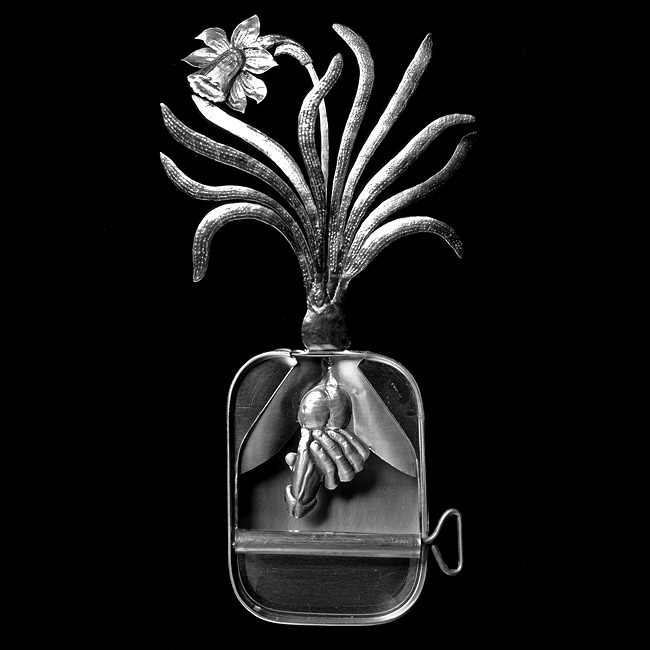
In an earlier series which I haven't seen in person, Paradisus Terestris, Hall creates intricate botanical sculptures out of sardine tins. The delicate, silvery sculptures speak of the vulnerability of plant species, and of the biodiversity present in Australia. Furthermore, the name of the series evokes themes of the garden of Eden, 'Paradise on Earth.' NB these ones are somewhat NSFW. Just a heads up.
Fiona Hall, Paradisus Terestris 1989-90
images from Roslyn Oxley9
Subscribe to:
Posts (Atom)