Showing posts with label sculpture. Show all posts

Jun 2, 2010

RIP, LB


One of the twentieth century's most influential sculptors, Louise Bourgeois, died on Monday aged 98. Bourgeois' work was largely unknown until the artist was in her sixties and seventies, despite the fact that over the course of her life she produced some of the most challenging and confronting sculpture of the twentieth century.

Bourgeois' sculpture is large scale, psychologically loaded, and frequently unsettling. The now eponymous giant cast iron spider is a testament ot all these qualities. The work's title, Maman (French for mother) shakes things up even further. Who would call a spider Mum? What kind of feelings does Louise Bourgeois expect us to feel for this behemoth arachnid? Yet the knowledge of its title completely changes our experience of the sculpture. Suddenly Maman is much more than just a giant spider: the work is a meditation on relationships, protection and vulnerability. Plus, by having people walk underneath the statue, Bourgeois says as much about the pregnant relationship between viewer and art object as Donald Judd did back in the sixties. 

Other works reference sexual ambiguity, human frailty, and in the case of Cell (Glass spheres and hands), which can be found at Melbourne's NGV, the complexities od childhood. I've only briefly studied Bourgeois, so am certainly not the most authoratative source. If you do want to read a little more about her, there is an excellent write up at the art daily with Lydia, which I stumbled upon while googling Louise Bourgeois, and will now be keeping an eye on. There is also an intellgent and thoughtful article at the New York Times.


Image credits:
1. Maman at Milan's Musem di Capodimonte
2. Cell (glass spheres and hands) fromt he National Gallery of Victoria's permanent collection
3. Maman at the Tate, London

Mar 3, 2010

The Bernini Effect


Last year, whilst in Italy, I had the priviledge of seeing two of Baroque sculptor Gianlorenzo Bernini's masterworks: The Rape of Proserpine, and Apollo and Daphne at the Villa Borghese in Rome. Previous to this encouner, whilst I had studied sculpture, it had never really struck me as something overwhelming or inspiring, didn't move me in the way painting and photography did. Largely because my main exposure to sculpture was via a slide projector in a lecture hall, and frankly, when this is the mode of viewing, poor old sculpture just doesn't stand a chance. In hindsight, this seems like a poor excuse -- after all, slides or no, I have plenty of opportunity to see contemporary Australian sculpture in the flesh -- but prior to standing before Bernini's marble virtuosities, completely overwhelmed, I really wouldn't have been in the right frame of mind to appreciate it.


Let's backtrack a bit. Why Bernini, why so overwhelmed? Well, for starters, over the course of my month in Rome, my fellow students and I came to learn that one Gian Lorenzo Bernini was The Man as far as Baroque sculpture is concerned. During the Renaissance, sculpture was largely concieved as something static, to be viewed from a fixed point. Flemish sculptor Giambologna began to challenge this static notion of sculpture, with works such as The Rape of the Sabine Women being characterised by intertwined figures and a sense of dynamic movement. Bernini takes Giamobologna's initial advances and perfects them, and with Apollo and Daphne and The Rape of Proserpine there is most certainly not a fixed viewing point, but rather the sense that from every angle, a new aspect of the narrative is conveyed. Moreover, at every angle, the marble seems to take on a different character. Pluto's fingers stab into Proserpine's thigh, making deep indents. Her leg looks fleshy and soft, as if it would wobble when touched. At the other side of the statue, Pluto's leg is entirely different - an epotiome of chiseled musculature. As we move around, our focus shifts from Pluto's sheer masculine power, to Proserpine's sheer terror. Her toes are curled and a tiny tear winds its way down her cheek.


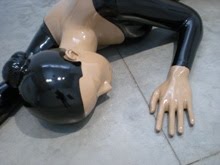
So there you have the starting point for my blossoming relationship with sculpture. Fast forward to June 2009 when I was back in New Zealand. Left in my hometown on a weekday with my friends and family all either at work or school, where else did I go but to the Auckland Art Gallery. At present, the gallery is in the middle of a multi milion dollar renovation and extension, and as such only the "New Gallery" across the road from the older, main gallery is open. Disorganised as I was, I arrived not even knowing what exhibitions were showing, and was pleasantly surprised to find an entire floor dedicated to an exhibition of the gallery's recent acquisitions. Whilst all the works on display were fantastic in their own right, my clear favourite was in the very last room, and in fact had the entire room to itself. Michael Parekowhai's The Song of the Frog is massive, dominating the entire room. It is hard to capture its impact in words: essentially it is a giant fibreglass ballerina, lying prone on the gallery floor. But a closer look reveals that despite her Barbie-like pink legs, the ballerina's face and hands are brown. This, coupled with Parekowhai's use of fibreglass and automotive paint, gives a starting point for exploring the undercurrent of satire and social commentary contained in his work.


So, Bernini, then Parekowhai, and I still have yet to mention the artist who has inspired all this sculpture related verbosity: Ricky Swallow. That's right, I managed to see his show four times but somehow missed posting about it until the damn thing had finished. And given how wordy I have been about Bernini and Parekowhai, I'm not even going to tell you anything about Swallow right now - that will have to come tomorrow, as The Bernini Effect part two. You see Ricky Swallow's NGV show was so awesome that a rushed description at the bottom of a mammoth post will just not do it justice. Oh no, it deserves verbosity all to itself. Stay tuned.

Gianlorenzo Bernini, Apollo and Daphne from here and here
Gianlorenzo Bernini, The Rape of Proserpine from here and here
Michael Parekohwai, Song of the Frog taken by me
Michael Parekohwai, Horn of Africa from here
Michael Parekohwai, Kapahaka from here

Jan 29, 2010

Paul Barbera // Nicholas Jones

Featured on Melbourne favourite The Design Files this week was the photography of Paul Barbera, specifically a set of images from the studios of 3 Deep Design. The images come from a series entitled 'Where they Create,' which documents the working spaces of artists and creative businesses in Australia and internationally. As is to be expected of a design firm, 3 Deep work in a truly inspirational space (complete with a custom mural on the ceilng, hello!), but what really caught my eye was a link to a set of photos Paul had taken at the studios of Melbourne based sculptor, Nicholas Jones.

Nicholas works with books, and produces the most amazing, intricate objects, both by folding the pages to create new shapes, and by cutting and contouring back entire tops and sides of books to create new shapes. I first saw his work at the This is Not a Design Market which was run as part of Melbourne's Design Festival mid last year. Still being a poor student at the time, I had quite deliberately rocked up to the market with an empty wallet, and was left quite sad that I couldn't take one of Nicholas' creations home with me. Ever since then, his name keeps popping up - on blogs, in the paper, at Craft Victoria - as if the universe is trying to remind me of my foolishness. One day, I will have to make on of his book-sculptures mine, but until then, Paul Barbera's photos of his studio will have to do.


All images, Paul Barbera

Dec 2, 2009

Ah Xian

I first saw Ah Xian's beautiful and intricate busts at the National Gallery of Victoria for 2006's Contemporary Commonwealth exhibition. But, fool that I am, I promptly forgot all about them. Fast forward to 2009, and Ah Xian has won the Clemenger Contemporary art prize, and I feel vindicated for falling so madly in love with the busts I saw way back when, and eternally foolish for forgetting about something so striking. Usually Xian works in traditional Chinese materials such as jade, or shiny white porcelian painted with archetypal willow pattern designs. The series of sculpted busts featured in the Clemenger exhibition present a break with these traditional materials -- they are cast from concrete, which gives them a pale, matte finish. Despite the heaviness of the material, they retain an aura of delicacy, not least because each cast has been 'texturised,' so to speak, with inprints of leaves and flowers. Each bust is different, both in regards to the original head it has been cast from, and in regards to the design element, yet they are united by the ghostly beige of the concrete. As such, the installation continues a theme prevalent in Xian's earlier work -- that of cultural identity -- whilst also incorporating themes of alienation and dislocation. A worthy winner indeed.


Sep 22, 2009

Killing time until Ricky Swallow


Ok, so I did enjoy my trip to see ol' mister Dali, despite my apprehensions. But ever since, I have been feeling a little bored by the prospects at the NGV. Enter, stage left, contemporary Australian artist Ricky Swallow. Oh wow, oh wow, oh wow. Things are looking up.

Swallow creates intricately detailed sculptures of seemingly insignificant objects, everyday objects which have been rendered arbitrary through familiarity and regular usage. Pop culture objects which we all hold dear, yet don't think about in detail due to a cloud of nostaligia. Well, detail is Ricky Swallow's middle name, and his sculptures reinvent these forgotten objects, making them eternal rather than transient, and infusing value through both his choice of material and through the laborious process of hand carving. Did I mention, wow?

The NGV has subtitled the exhibition "The Bricoleur," which leaves itself open for several interpretations. The word itself is a little ambiguous, given that it has been borrowed into English from French, and translation is a slippery game at the best of times. Even I can't concretely say what I think it means. Having sifted through several definitions, the common understanding is that bricolage involves assembling art from disparate materials, making something from the bits and bobs you find around you. I find this a bit odd when used to describe Ricky Swallow, because despite various media featuring throughout his oeuvre, each sculpture is made from one carefully selected medium. The whole sculpture. And they are sculptures, too, not assemblages. That said, and this is where the issue of translation comes into play,bricoleur can also mean "to tinker," or "to fiddle," and the fiddly, painstaking detail on Swallow's sculptures makes such a term ideal for him.

The NGV explains its use of the term 'bricoleur' thus:
Like the bricoleur put into popular usage by anthropologist Claude Levi-Strauss in his seminal book The Savage Mind, Ricky Swallow creates works of art often based on objects from his immediate surroundings. His method, however, is more of a second order bricolage: his sculptures are not assemblages of found objects, but rather elegantly crafted things.

I would argue that there is a distinct difference between sculpture and/or art MADE FROM one's everyday surroundings, and art BASED ON objects from the everyday. The fact that Swallow's sculptures are carved from high quality timber works to create an ironic contrast with their subject matter. Form and medium have a complex and shifting interrelationship. Furthermore, the term bricolage carries associations of a hasty, roughly constructed item, which does not fit with the laborious, painstaking nature of Swallow's sculptures. Maybe I am reading too much into this, then again maybe I am just exited to have something new to talk about rather than Freudian dreams and anamorphic land masses. Bricoleur or no, I say bring on Ricky Swallow!

[Images of Swallow with Killing Time from here, here and here. Detail of Killing Time from the artist's website.]

Sep 3, 2009

Firenze in the rain


Found in Florence in February (say that five times fast):
Fantastic street art; dodgy bagmen on the run; peace and quiet (and some gruesome remains!) at San Marco; crazy detail on the Duomo; rain aplenty atop it; lonely emo scribblers on the lantern; and, well, that Daaaavid guy. He seems to have an awful lot of doppelgangers...! One more post of Florentine fotos, then a quickie from Milan and we're done! Whew is an understatement!

Mar 11, 2009

A trip, a trip, to the countryside

Tuesday of week two saw us wrap up warm and pack as much bus-friendly food as we possibly could, in preparation for a day long tiki tour north of Rome. Stops included Caprarola, Bagnaia and Bomarzo. Caprarola was reached after an arduous journey along some very windy, hilly road which was anything but bus-compatible. The town is basically a collection of very old houses clinging to the ridge of a big gorge. In the middle of it all is the rather imposing Villa Farnese. The villa is uninhabited, and basically remains a stop on the tourist tour. It feels a bit sad and unloved what with the big empty rooms. Out the back is a rather rambling woodsy type area that kept making me think of Beauty and the Beast (much to the dismay of my lecturer), which leads up to the garden proper, with a hedge maze and a large but sadly unused fountain. If anything, I think the hedge maze was the highlight of this stop.

Stop number two was the Castello Ruspoli in Vignanello. Vignanello is a tiny little town on a steep hill, with the castle quite likely being the largest building in the town. Streets are narrow, and we frequently passed under archways and up stone staircases to get to the castle.

Stop number three: Villa Lante in Bagnaia. Villa Lante was comissioned by Cardinal Gianfresco Gambarra, and it is the translation of his name, "crayfish," that drives the design of the Villa's famous feature series of fountains and water features.

Stop the last was the Sacro Bosco, or Moster Park - depending on the age of the visitor - at Bomarzo. The garden was created by Vicino Orsini to commemorate the death of his wife. Seems a bit strange to remember a loved one with monsters, but hey, it does make for an awfully interesting garden, so we weren't complaining. I think this is far too much text already, so without further ado, ze photographs:

Related Posts with Thumbnails