Mar 8, 2010

Brick by brick


Ascending and Descending, Lego style, by Andrew Lipson

Oh yes, M.C. Escher, in the form of hundreds and thousands of plastic bricks. The ultimate in obsessive compulsive, nerdy goodness. Lipson provides detailed progress shots on his website, so you can figure out how the mind bending constructions actually work.

Images, from top: Ascending & Descending, Relativity, Belvedere, Waterfall, Balcony

Mar 6, 2010

PWNED BY ART

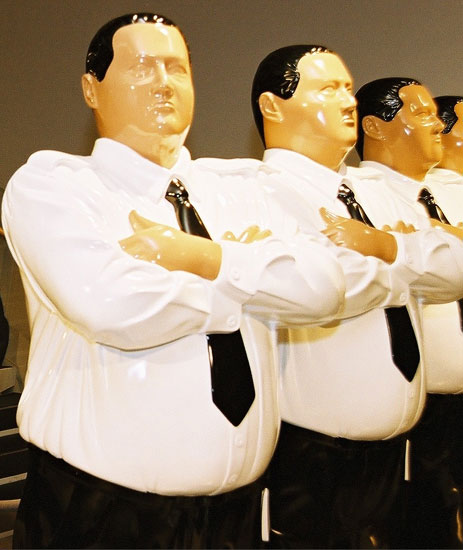
image from third drawer down's online store

I'd spotted this poster by Parisian-based artist Vuk Vidor online in a few places, and then, after picking up my Risographica prints from Lamington Drive gallery last weekend, I wandered into the seriously awesome Third Drawer Down only to see it in all its framed, lifesize glory, oh-so-close and yet still out of my pricerange. Maybe a completed-thesis present to self, somewhere down the track...?

NB: Someone commented on one of the design blogs that this was featured on, that the poster is "the ultimate expression of retarded name dropping"...somthing tells me they just don't get it. Vidor is making fun of the very idea of name dropping, rather than indulging in it himself. Homage, yes, but probably the most fun and light hearted homage I've seen in a long time. The only issue that I do have with it is the lack of female artists on the list. Yet the more I think about this I am left wondering whether this is an omission on Vidor's part, or just an inherent flaw in twentieth century western art history. 

 
 images via art milk

Mar 4, 2010

in two parts - sydney style

the supporting structure, randwick, from 52 suburbs

Sydney photographer Louise Hawson is on a mission: To nose around one new suburb every week for a year, in search of the beauty in the 'burb. Beauty in this case meaning old, original, retro, rusty, repurposed, nostalgic...
Louise has spent the last seven or so months doing just that - finding beauty in unexpected places, and capturing the essence of each suburb. A weekly post on her blog 52 Suburbs documents her findings. Reoccuring themes include the diverse cultural makeup of each respective suburb, a plethora of architectural styles, and an eye popping dose of colour and patterns. Moreover, Louise makes clever use of the diptych format, pairing people and architecture, manmade and natural in a way that adds further meaning, gravity and humor to her already fantastic images.

Louise is now up to her 25th suburb, and let me tell you, the hardest thing about putting together this post was choosing a shortlist of images to include. As I rummaged through her archives, more and more beautiful photos jumped out at me. So, if like me, you find yourself captivated by the few images I've put together here, GO GO GO. Have a read of her recent posts, have a read of her archives. They are truly magnificent, and will make even the most observant of us (this means me!) feel like we have been walking around with blinkers on. Inspiration overload, and a reminder that you don't need to travel overseas to find beauty. It's right around the corner, in that suburb you speed through on the train to get to work, in the people that call it home. 

PS: Louise posts on Mondays. As far as I'm concerned, poring through a set of her images is a lovely way to start the week. Also, a 52 suburbs book is in the works. Doesn't it give you a bit of a warm fuzzy feeling when you see an awesome creative project taking flight? I'll certainly be heading to the bookshop, wallet in hand. If you can't wait for the book, and simply must have some 52 suburbs goodness in your hot little hand, Louise also has an etsy shop where she sells postcards featuring images from 52 suburbs. Lastly, a more in-depth interview about 52 suburbs can be found on the blog of interior design magazine Inside Out.


1. a seagull's worst nightmare, Brighton-Le-Sands
2. similar vintage, Glebe
3. heavenly light, Ingleside
4. ballet pink, Randwick 
5. wallpaper and tiles, Randwick 
6. bright sparks, Wahroonga
7. are my seams straight?, Wahroonga
8. pretty flash, Wahroonga
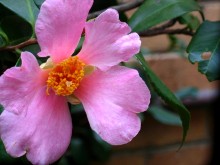
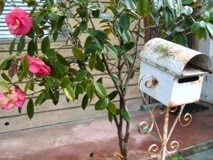
9. rose and hankie, Randwick 
10. hands on hips, Randwick
11. stairway to heaven, Brighton-Le-Sands
12. everyone's welcome, Randwick
13. i see a bridge in your shoes, Glebe
14. fly free, Clovelly 
15. patterns and colours, Cabramatta 
16. daily coffee, Liverpool 
17. love letters, Randwick
18. light is everything, Surry Hills
(click on the suburb to explore the rest of the post)

Mar 3, 2010

HOLY CRAFT KNIVES, Batman!

So, you know how I keep posting paper-cut art and saying things like "If only I had such patience..." or, "If only I was that skilled with the stanley knife..."? Well, I think this one takes the cake. Twenty hours of cutting transcribed into two minutes. The finished product? A papercut map based on the cultural identity of New York. Let's all heave a big "If only..." sigh, and be glad that someone out there is talended and fiddly enough to work such magic.


PS. Even more pain-inducing is the fact that the artists responsible for this papercut, Famille Summerbelle, are selling prints of their three city-map papercuts (New York, Paris and London). Meels-wants, bigtime. Yeouch.

via Black Eiffel.

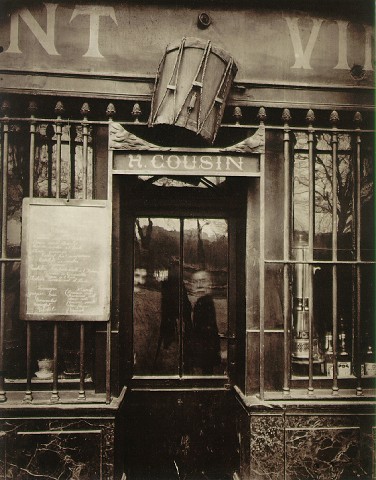
ghost city: eugene atget's paris

image via


As mentioned in an earlier post, the BBC series The Genius of Photography led me to the work of Eugene Atget: a French photographer, documenting a rapidly disappearing side of Paris in the late nineteenth century.  Entire neighbourhoods which took their shape from the narrow, medieval roads, were reformed in the wake of Baron Haussmann's renovations of  Paris. Atget was elderly when he was taking his series of images of Paris, and persisted with dated cameras and methods, despite advances that had been made in photographic technology. Stubborn, talented, and fascinating - all the right things to be. Moreover, Atget is interesting in relation to his influence on the surrealists. Like archaeologists, they credited themselves with 'discovering' the aging photographer, and they treated his photographs as 'found images' - historical images became a source of the uncanny and unexpected. Looking at Atget's photographs provides not only an education in formalism, but also a journey back in time.

 image credits: 1, 2, 3, 4, 5, 6

The Bernini Effect


Last year, whilst in Italy, I had the priviledge of seeing two of Baroque sculptor Gianlorenzo Bernini's masterworks: The Rape of Proserpine, and Apollo and Daphne at the Villa Borghese in Rome. Previous to this encouner, whilst I had studied sculpture, it had never really struck me as something overwhelming or inspiring, didn't move me in the way painting and photography did. Largely because my main exposure to sculpture was via a slide projector in a lecture hall, and frankly, when this is the mode of viewing, poor old sculpture just doesn't stand a chance. In hindsight, this seems like a poor excuse -- after all, slides or no, I have plenty of opportunity to see contemporary Australian sculpture in the flesh -- but prior to standing before Bernini's marble virtuosities, completely overwhelmed, I really wouldn't have been in the right frame of mind to appreciate it.


Let's backtrack a bit. Why Bernini, why so overwhelmed? Well, for starters, over the course of my month in Rome, my fellow students and I came to learn that one Gian Lorenzo Bernini was The Man as far as Baroque sculpture is concerned. During the Renaissance, sculpture was largely concieved as something static, to be viewed from a fixed point. Flemish sculptor Giambologna began to challenge this static notion of sculpture, with works such as The Rape of the Sabine Women being characterised by intertwined figures and a sense of dynamic movement. Bernini takes Giamobologna's initial advances and perfects them, and with Apollo and Daphne and The Rape of Proserpine there is most certainly not a fixed viewing point, but rather the sense that from every angle, a new aspect of the narrative is conveyed. Moreover, at every angle, the marble seems to take on a different character. Pluto's fingers stab into Proserpine's thigh, making deep indents. Her leg looks fleshy and soft, as if it would wobble when touched. At the other side of the statue, Pluto's leg is entirely different - an epotiome of chiseled musculature. As we move around, our focus shifts from Pluto's sheer masculine power, to Proserpine's sheer terror. Her toes are curled and a tiny tear winds its way down her cheek.


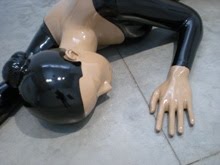
So there you have the starting point for my blossoming relationship with sculpture. Fast forward to June 2009 when I was back in New Zealand. Left in my hometown on a weekday with my friends and family all either at work or school, where else did I go but to the Auckland Art Gallery. At present, the gallery is in the middle of a multi milion dollar renovation and extension, and as such only the "New Gallery" across the road from the older, main gallery is open. Disorganised as I was, I arrived not even knowing what exhibitions were showing, and was pleasantly surprised to find an entire floor dedicated to an exhibition of the gallery's recent acquisitions. Whilst all the works on display were fantastic in their own right, my clear favourite was in the very last room, and in fact had the entire room to itself. Michael Parekowhai's The Song of the Frog is massive, dominating the entire room. It is hard to capture its impact in words: essentially it is a giant fibreglass ballerina, lying prone on the gallery floor. But a closer look reveals that despite her Barbie-like pink legs, the ballerina's face and hands are brown. This, coupled with Parekowhai's use of fibreglass and automotive paint, gives a starting point for exploring the undercurrent of satire and social commentary contained in his work.


So, Bernini, then Parekowhai, and I still have yet to mention the artist who has inspired all this sculpture related verbosity: Ricky Swallow. That's right, I managed to see his show four times but somehow missed posting about it until the damn thing had finished. And given how wordy I have been about Bernini and Parekowhai, I'm not even going to tell you anything about Swallow right now - that will have to come tomorrow, as The Bernini Effect part two. You see Ricky Swallow's NGV show was so awesome that a rushed description at the bottom of a mammoth post will just not do it justice. Oh no, it deserves verbosity all to itself. Stay tuned.

Gianlorenzo Bernini, Apollo and Daphne from here and here
Gianlorenzo Bernini, The Rape of Proserpine from here and here
Michael Parekohwai, Song of the Frog taken by me
Michael Parekohwai, Horn of Africa from here
Michael Parekohwai, Kapahaka from here
Mar 2, 2010

still in Eastern Europe...

...this time with Russian artist Alexander Rodchenko. I studied Rodchenko many years ago at high school, but only in the context of constructivism. It wasn't until I watched an episode of BBC series, The Genius of Photography that I learnt that he is as much a photographer as he is a sculptor. And not just any photographer, either. Rodchenko worked to create photographic propaganda and collages for the Bolshevik government during the 1920s. Effectively, he wrote the book on Soviet photomontage. 

Sadly, these small and somewhat grainy images were all I could find online of the work Rodchenko did for Soviet propaganda magazine USSR in Construction. Moreover, the tactile nature of the magazine and the way the pages are designed to fold out to show more photographs are both lost in a visual reproduction. My best advice would be to watch the BBC docco itself. Other gems (which may well warrant a post themselves) include Eugene Atget's chronicling of the disappearing medieval streets of Paris, and August Sander's catalogue of all the people of pre-Nazi Germany. 


images via

Mar 1, 2010

boris mikhailov and the blue hour

Yes, I am at it again with the blue photography, but these are not cyanotypes; they are tinted photographs. In the series, At Dusk, Ukranian photographer Boris Mikhailov recorded his homeland at the time of the collapse of the Soviet Union. To use a word that has been irrevocably altered by one teen fiction series, it is twilight photography - both literally and metaphorically, for Mikhailov is shooting a sociey in transition in what is effectively at the sundown of an entire political era.

image 1 from the Guardian, images 2-8 via the Victoria and Albert museum
Related Posts with Thumbnails